The Tuesday Test: Why Your Next Print Should Suit Your Real Life, Not Your Imaginary One
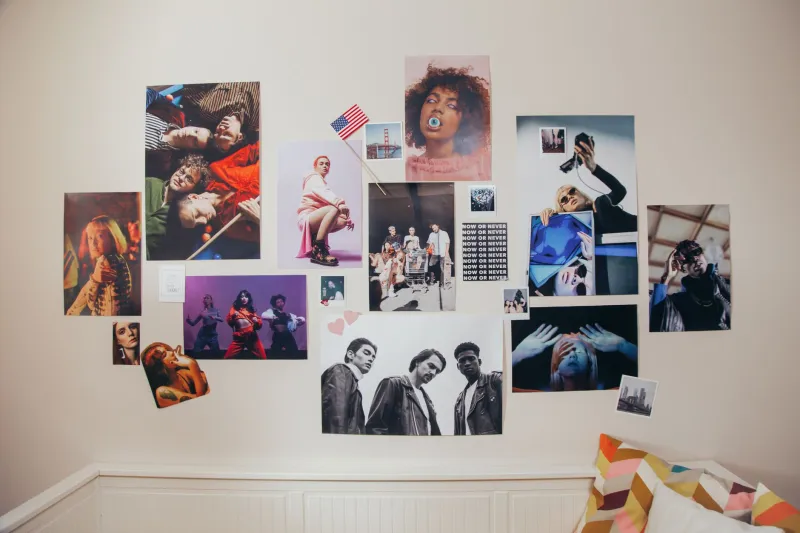
Buying a poster can feel like buying a personality. You see a smoky jazz-club print and imagine late-night records and good glassware. You spot a French New Wave still and picture yourself as the kind of person who casually references Godard. None of this is wrong, exactly. It is just a very expensive way to decorate for a stranger.
The stranger is usually an aspirational version of you: tidier, more cultured, less likely to eat toast over the sink. That person has a spare room for framing and a wall that never gets direct sun. The rest of us have a rented flat in Bristol with a north-facing living room, a radiator where the gallery wall should go, and a bike leaning against the only blank space.
The fantasy flat problem
Print shopping is uniquely vulnerable to aspirational thinking. A sofa is constrained by measurements and delivery slots. A print is not. It can be bought in a lunch break, slipped into a tube and stored under a bed for eighteen months while you wait for the right wall to appear.
Social media has made this worse. Every scroll serves another beautifully lit corner: a monolithic film poster, a rare gig print, a minimalist typographic piece that suggests its owner has never owned a phone charger. The result is a lot of homes filled with art chosen for an imagined life rather than the one being lived.
That is not a moral failure. It is just a mismatch. And mismatches tend to end up in the hallway, unframed, quietly annoying you every time you move the vacuum.
What aspirational buying actually costs
The obvious cost is money. The bigger cost is wall space. In a small UK flat, a wall is a finite resource. Every print you hang for a fantasy self is a print you cannot hang for the actual self who sits there on a Sunday,
The second cost is framing. A budget A3 print can feel like a bargain until you factor in a decent frame. Multiply that by five aspirational buys and you have spent real money on art you do not really like. The third cost is mood. A print that is too loud, too cool or too precious can make a room feel like someone else's. You do not want to live in a hotel lobby that happens to have your kettle in it.
The Tuesday Test
Before you buy, run the print through a simple test. Imagine it is a wet Tuesday in February. The bin has been missed. You are in slightly damp socks. Does the print still make sense in that room?
Ask five questions:
- Where exactly will it hang? Not roughly. Exactly. Above the sofa? Beside the door? Leaning on the shelf because you cannot drill into the wall?
- Can you see it from where you actually sit? A print that only works from the doorway is a print for guests, not for you.
- Does it fight the room? Be honest about the paint, the sofa, the rug and the light. A moody film still can disappear in a dark corner. A bright graphic can overwhelm a small bedroom.
- Would you still like it on a bad day? Good art can lift a mood. Bad art can feel like a chore.
- Will you frame it within a month? If the answer is no, ask why. Sometimes the answer is money. Sometimes the answer is that you do not love it enough.
If you fail three or more, leave it. There will be another print. There always is.
Match the print to the room's job
Rooms are not galleries. They have jobs. A hallway is a passing place, so it can take something graphic and sturdy: a bold film one-sheet, a venue print from a gig you actually attended, a simple typographic piece that reads in two seconds. A kitchen is steam and splashes, so keep it cheap and cheerful or frame it properly. A desk wall is for focus, not clutter. One A3 music print above a monitor can do more than six prints fighting for attention.
The living room is where the statement piece belongs, if you want one. That is the room where you linger. A single large film print or a beautifully printed tracklisting can carry a wall on its own. It does not need a supporting cast of aspirational buys.
At Zip! Posters, the bestsellers tend to be the prints people can connect to a real memory: the Picturehouse screening they still talk about, the Rough Trade find, the gig at a scuffed venue that smelled of sweat and cheap lager. Those prints earn their place because they are not pretending.
A UK-friendly buying checklist
Measure the wall before you fall in love. Use masking tape to mark the print size on the wall and live with it for a day. Check the frame cost before checkout. A £20 A3 print is not a £20 wall if the frame is £45. Rented walls need non-damaging fixings, but check weight limits; Command strips are not magic. Keep prints out of direct sun if you care about fade. Ask about paper weight and whether the print is acid-free.
Budget A3 buys can be brilliant. They are low-risk, easy to swap and look good in small flats. Statement pieces can be brilliant too, but only when they are chosen for the room rather than the fantasy. A £120 print that suits your actual living room beats a £40 print that suits an imaginary loft.
When aspiration earns its place
This is not a ban on ambition. One aspirational piece can be a good thing. It can be a nudge towards the life you want, or simply a bit of beauty in a room that is mostly laundry. The rule is simple: do not furnish a whole wall from a fantasy. Buy one stretch piece, hang it properly and let the rest of the room stay honest.
Your walls should say something about you. Not a stranger with better lighting and no recycling bin. The best print is the one you notice on an ordinary Tuesday and still like.