Budget Frames, Big-Cinema Energy: A £100 Blueprint for a Film-Print Gallery Wall
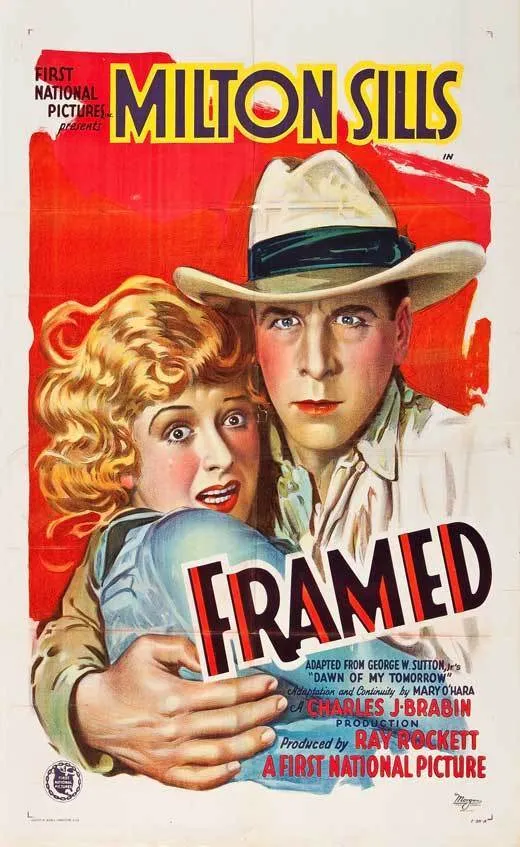
Photo: First National Pictures, Public domain, via Wikimedia Commons
There's a particular look that budget film prints get when nobody intervenes: a glossy A2 of a Nineties one-sheet, four blobs of blu-tack, corners curling by February. The print cost eight quid. The print was never the problem.
Framing is where the money shows. A £12 poster in a secondhand frame with a properly cut mount will out-class a £60 print in a clip frame every day of the week. What follows is a plan for a whole wall for about £100 — frames, mounts, fixings, the lot — without pretending you've got a Mayfair framer on speed dial.
Before you buy anything, check the paper
Cheap reproduction prints tend to arrive on high-gloss stock, and gloss is the enemy. It reflects every lamp and window in the room, and it photographs like a magazine page. Matte, uncoated or lightly textured paper reads as 'art print' rather than 'poster from a cinema foyer', even when it cost the same.
Two more checks. First, sizes: stick to A3, A2, 30x40cm, 40x50cm and 50x70cm. Standard sizes mean standard frames, and standard frames mean you're not paying a framer £70 to build you a box. Second, borders: a print with a small white margin gives you breathing room and forgives a slightly wonky mount aperture.
Spend here, save there
The single biggest mistake is spending evenly. Put your money in three places and let everything else be cheap.
Spend on the mount. A properly cut mount is the difference between 'framed poster' and 'print'. A local framer will cut mounts to your exact aperture for £7–12 each — genuinely one of the last bargains on the high street.
Spend on the hanging hardware. Proper D-rings and two hooks per frame, not one nail and a piece of string. Nothing undoes a nice wall faster than four frames all tilting at slightly different angles.
Spend on one decent frame for the anchor print. If there's a centrepiece, it deserves the good one.
Save on the moulding. Nobody is inspecting your frame profile from a metre and a half away. IKEA's Hovsta and Fiskbo ranges, Dunelm, The Range and Hobbycraft all sell perfectly respectable A3 and A2 frames with mounts for under £15. Charity shops are the real goldmine: ugly 1980s landscapes in solid wood frames with good glass, £2–4 each, and the artwork goes in the bin.
The mount is the whole trick
If you take one thing from this piece, take the mount.
Width matters: 5–8cm of visible mount around an A3, 7–10cm around an A2. Colour: off-white, ivory or a warm pale grey. Brilliant white against a white wall tends to look thin and a bit office-y.
Then bottom-weight it. Ask for an extra 10–15mm of mount at the bottom so the image sits optically centred rather than mathematically centred. It sounds like nonsense. It is not nonsense. It is the cheapest 'expensive' move available to you, and it costs nothing if you're ordering the mount anyway.
Glass, acrylic and the shine problem
Most budget frames ship with styrene or acrylic rather than glass. It's lighter and safer, which matters if the wall is above a bed, but it scratches if you look at it wrong and it holds static like a magnet for dust. Real glass is better if you can find it secondhand.
Non-reflective glass costs more than your print, so skip it. Instead, think about where the wall is: a print facing a window will be a mirror from 4pm onwards in winter. Hang on a side wall, or opposite the window rather than facing it, and you've solved most of the glare for free.
Fading is real, by the way. Cheap inks in a south-facing room will visibly soften within a few summers. Not a reason to panic, just a reason not to hang your favourite print in the one spot that gets direct sun all afternoon.
Layout templates that dodge the halls-of-residence look
Four that work, in ascending order of nerve.
The 2x3 grid. Six A3s, identical frames, identical 6cm gaps. The safest possible wall, and it looks deliberate because it is deliberate.
The film strip. Four A3 or A4 landscape stills in a single row. Works beautifully along a hallway or over a low sofa where a grid would feel heavy.
The column of three. One A2 and two A3 stacked vertically. The answer for a narrow chimney breast, a gap between windows, or the awkward strip beside a door.
The salon wall. One anchor (A2), two mediums (A3), three or four smalls (A4). Work it out on the floor first, then cut paper templates, tape them to the wall and live with them for a week. You will change your mind twice. That's the point of the paper.
The rules that quietly do the heavy lifting
Centre line at about 145cm from the floor. That's roughly eye level for most adults, and it's the standard galleries use. Hallways want it slightly lower, more like 135cm, because you're usually looking down as you walk.
Gaps: pick a number between 5 and 8cm and never deviate. Consistency reads as intent. Above a sofa, leave 15–25cm between the frame and the top of the backrest so nobody's head is in the art.
On a chimney breast, keep the whole arrangement inside the breast width. Spilling over the edges makes the wall look like it lost an argument.
If you rent: adhesive strips are fine up to about 3kg and will genuinely come off cleanly, but a row of six A2 frames is not 3kg. Two small hooks and a tube of filler is a ten-minute job and a lot less stressful than a print landing on your head at 2am.
Lighting, which is cheaper than you think
A rechargeable picture light is £15–25 now and clips or screws above a frame in minutes. One over the anchor print changes the whole wall at night. If you've got a plug nearby, a simple wall sconce does the same job. Warm white, around 2700K, and never anything that points straight down the glass.
The honest £100 receipt
Prints: four at £7 each from a print site or a gallery shop's bargain bin — £28. Or £0 if you're framing what you already own, which is the actual smart move.
Frames: two new A3 with mounts at £12 each, two charity-shop wood frames at £3 each — £30.
Mounts: four cut to size at a local framer, £7 each — £28.
Hardware: hooks, D-rings, a small spirit level — £8.
That's £94 for the wall. The picture light is next month.
The tell was never the print. It's the gap, the mount and the tilt.